Case Study: Standardization in the New Home Introduction

December 19, 2009 by Mike Macaluso


Change is tough — especially when you’re changing (or standardizing) something that your Teammates have been doing their own way and have established habits — both good and bad.

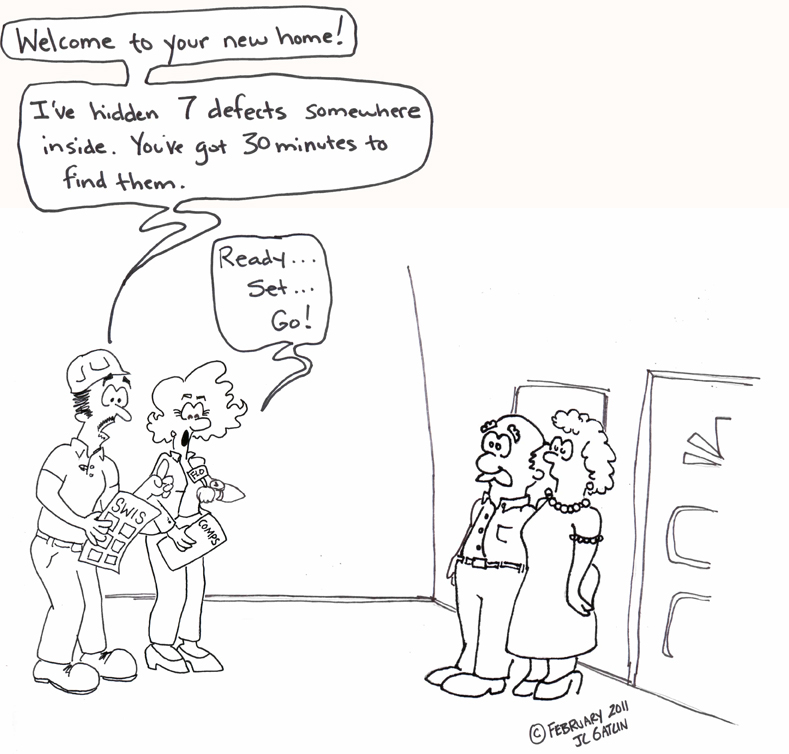
We began standardizing the way we present the New Home Introduction to the Home Buyer — the walk through of their home a couple of days before closing. For some Construction Professionals, they were spending 45 minutes conducting the Introduction. Another Construction Professional could intro the same size home and spend 3 hours. Some would go over every detail about the home warranty and another wouldn’t even mention it. Worst of all, a lot of our home buyers had the expectation that they needed to go through the home and look for anything and everything wrong. In fact, one homebuyer actually brought his own roll of blue tape so that he could mark the walls. It was crazy.

We began the standardization process in November ‘08 and have been patiently but adamantly enforcing the standard since. Back in ‘08, our first step was to show the need to standardize the process and get every Construction Professional delivering a consistent message, focused on re-selling the home and delivering a pleasurable home buying experience. We then provided education on how to achieve it. All of our Construction Professionals wrote Kaizens about the problems they experience with their current way of doing it and everyone read a chapter about conducting the New Home Intro in a customer service book endorsed by the National Association of Homebuilders.

In early ‘09, a few Construction Professionals — guys who actually do the New Home Intro, no management — initiated a PDCA to improve and standardize the process. We hired a consultant to work with them and develop the standard. He walked us through a house and asked us about some of the problems we face. He then taught us how to overcome those problems and even how to avoid them. I led the PDCA group and it was one that we constantly had to go back and check/adjust a few times before we really had an idea of how to standardize it.

By Spring ‘09, the PDCA group rolled out the new standard across the company to all Construction Professionals. We created SWISes (Standardized Work Instruction Sheets) with photographs for all the Construction Professionals to follow. Then that summer, the PDCA group set up a “certification process” in which we coached our peers in performing the process.  We ”certified” those that were doing it correctly — and even had the difficult time telling a few Construction Professionals to try again.

By Fall ‘09, almost all Construction Professionals have been “certified” by the PDCA group and our Construction Team has a collection of success stories about the benefits of the new process.

It was a slow roll-out and we are now on the adjust step of the PDCA process. We are continuing to improve the process based on the results we have had since its inception. The change was gradual but once everyone experienced some success it became clear why the change needed to be made. I think the most important step was that, while the leaders of the company (management) initially saw the need for change, they let those closest to the problem truly lead the change. It has been one of our best examples so far.

— Mike Macaluso, Construction Professional

© December 2009 Homebuilding Partners, Inc.   twitter-logo

Warranty defects were made for PDCA

December 13, 2009 by JC Gatlin

What do you do when you receive a warranty request from a Homeowner?

The average Superintendent contacts the appropriate trade to go to the home to fix the defect then follows up with the Homeowners to ensure the problem has been resolved to their satisfaction. This works for the average homebuilder. This is unacceptable to a lean homebuilder.

Simply fixing defects exposed through warranty requests – no matter how quickly and how completely those issues are resolved – will single handedly destroy a builder’s lean progress. This includes any waste elimination, building process & schedule improvements, and cost reduction efforts that have been made. In fact, warranty defects are arguably the leading waste factor for every home builder.

Sometimes warranty costs are so buried that their true cost in wasted time, resources, and dollars is hard to measure.  This is the expense of 2nd Time Quality, and it will nickel and dime a homebuilding company and eat a Construction Professional’s time and reputation.

A Construction Professional for a lean homebuilder should at all times know the top warranty defects in his houses. And, he must constantly monitor the systematic prevention of any recurrences. That prevention is called 1st Time Quality. So where does he start?

Step 1: List the Top 5 warranty defects in your community

Look through past warranty requests for trends. Then, starting today, keep a running log of the warranty requests submitted by your homeowners.  Log everything. Never discount a request because of a Homeowner’s attitude or because you think it’s a one-time anomaly. It’s not.  Warranty defects are like cock roaches: where there’s one there’s hundreds just like it that you can’t see. Once you compile the list, commit to eliminating those defects by a target date.

Step 2: Work with your Building Partners to get to the root cause

Tie each defect back to your FTQ scores and to a specific construction activity in the home building process. Then start the PDCA process on each defect. Don’t even think about working a PDCA without the Building Partner. Get them involved in finding the root cause and the counter measures to keep it from ever happening again.

Under no circumstances do you name the Homeowner as the root cause and then call it a day. Yeah, okay. Sometimes it’s tempting, I’ll give you that — especially when improper use or maintenance creates the defect. But you and your Building Partner are being shortsighted if you don’t look for WHY the Homeowner is misusing or not maintaining something.

Step 3: Standardize

Update the Standardized Work Instruction Sheet or create Hot Spot Sheets to standardize the way the work must be done within that construction activity. Work with your Building Partner to come up with the best way for them to communicate the standard to their team. And don’t be afraid to think outside the box: if a defect is occurring because of Homeowner misuse – how can we educate & inform Homeowners on proper use and maintenance?

Step 4: Follow-up

Follow-up. Follow-up. Follow-up. I can’t say it enough. Make a point to be on the jobsite when the construction activity is occurring to go over the SWIS or Hot Spot Sheets. Keep your warranty log updated, and a watchful eye for this defect to resurface as you tackle the next Top 5 warranty defects in the homes you build.

© December 2009 Homebuilding Partners, Inc.   twitter-logo

Counter Measures: Who’s Responsible?

December 6, 2009 by JC Gatlin


I know what you’re thinking… You get to the counter measure and say, “Sam and I are going to implement this task together.” So you list “Yourself/Sam” as the responsible person on the PDCA. It won’t work.

Ever heard the saying, “A dog with two masters is either very fat or very thin?”

If you and Sam both are responsible for completing the task, sooner or later one of you will think the other is doing it and then — BOOM! — the task is left incomplete.

A counter measure is assigned to one person on the PDCA group only. That responsible person will ensure that the counter measure is initiated and completed by the target date. Then, later, that responsible person will follow-up to see if the counter measure actually achieved the expected results. The responsible person is ALWAYS a member of the PDCA group — never someone outside the group. And never, ever is the responsible person a position title.

But wait a minute — what if you really want to implement this counter measure with Sam? That’s fine. You can both work on it together. But first you must choose: Are you responsible for ensuring the improvement is made or is Sam responsible?

It’s like feeding the dog: Maybe another member of your household takes a turn filling the dog bowl. But at the end of the day, it’s up to you to make sure the dog doesn’t go hungry.

© December 2009 Homebuilding Partners, Inc.   twitter-logo

Managing a full PDCA WIP (Work In Process)

November 30, 2009 by JC Gatlin

One of our Construction Professionals recently asked me, “How do I manage all my PDCAs? I simply don’t have time to complete them all.” He’s currently the leader on two PDCA groups. He has 4 PDCAs addressing warranty issues. 4 PDCAs from FTQ inspection sheets and 8 PDCAs on building process & Building Partner issues. He’s working on a PDCA with the Production Planners on take-offs for a new floor plan. He’s working with the Sales Professionals on 2 sales related PDCAs.  Plus, he has 19 PDCAs that require follow-up. On top of all this, he’s got a waiting list of waste and other problems that he’d like to PDCA but just hasn’t gotten to yet — and all these numbers keep growing.

I can’t get my arms around all these PDCAs,” he said. “I feel like I’m drowning.”

That can’t be uncommon – and he’s not the first Teammate to express this. So, I’ve been giving it a lot of thought. How do you manage a full PDCA WIP? Well, you start with perception.

1. Understand where the pressure is coming from.

You’re not trying to get your arms around a full PDCA WIP; you’re getting your arms around runaway problems and rampant waste.

PDCA is about problem consciousness. Before we began learning about, practicing and implementing lean principles, we weren’t aware of recurring problems and waste. We simply reacted and jumped to work-arounds and fixing symptoms. We were ignorant of wasted resources, time and money.  

But you can’t put the genie back in the bottle — once you’re aware of it, you see it everywhere.

2. Understand that PDCA is a tool – not a task.

Like scheduling is an inseparable component of the homebuilding process, so is problem solving. To improve cycle time and reduce building errors, defects and rework, you’ve got to constantly improve. You do that using Kaizen and PDCA.

All of the problems that the Construction Professional is trying to get his arms around exist whether or not he’s working PDCAs. He’s drowning in waste, not PDCAs.

3. Measure problems, not PDCAs.

That Construction Professional is not trying manage 19 PDCAs — he’s eliminating 19 problems. Remember, the point. You’re eliminating waste and other problems preventing you from achieving a goal. And, you’re using PDCA to do that.

Keep a progress log of recurring problems in the back of your manual. This will not only help you organize and get your arms around it, but will show improvement. You probably don’t even realize how much progress you’ve already made. Looking back 6-months, 12-months, 18-months later, you’ll see problems that no longer plague you. Recognizing this success is crucial. Otherwise you may feel like you’re simply spinning your wheels.

Keeping a written  log of problems will make connections visible. Many problems are symptoms of the same root cause. Once you identify and eliminate that root cause, many recurring problems will disappear, reducing your WIP.

4. Schedule time dedicated to problem solving.

In the conversation with the Construction Manager, I found that he organizes his day so that he is updating his construction schedule for 30 minutes in the morning, and then again after the afternoon walk of his houses. He schedules “Scheduling Time” in his day. Scheduling dedicated problem solving time is no less important.

Make time for strategic thinking. This is when you’ll analyze what’s going on in your community. Work PDCAs with Building Partners and fellow Teammates. Sharpen your problem solving skills by reading books and articles, or doing Internet research. Record recurring problems in your log. But you must schedule this time because it’ll be easy to sacrifice it for something else.

In the end, this is probably the most important step of all…

Schedule it in your Outlook calendar, right now….. Yes, right now. Stop reading this blog and schedule it…. What are you still doing here? I’m serious. Minimize this window and schedule problem solving time.

© November 2009 Homebuilding Partners, Inc.   twitter-logo

The Goal Statement: My point is and I do have one…

November 15, 2009 by JC Gatlin

Mirror2

Have you ever heard the old saying, “Behind every great problem statement is a great goal statement?” Probably not…

Goal statements rarely get the attention that the problem statement or root causes receive. They just kind of hang out like some fleeting after thought. More often than not, they’re reduced to fragmented sentences scribbled on the PDCA form before we move on.

But the goal statement is, arguably, the MOST CRITICAL component of the PDCA. We just don’t realize it because we don’t understand what its job is. So, here’s a job description for the goal statement.

1. The goal statement is the whole point of the PDCA. Yes, you want to solve a problem. But unless you’re a detective — or possibly some kind of super hero — your job isn’t to just solve problems. You’re trying to accomplish something, be that to make more sales or to reduce cycle time or meet a deadline. But there’s an obstacle keeping you from achieving that goal. Thus the point of the PDCA and the importance of the goal statement.

2. The goal statement is the PDCA’s compass. It sets the direction for the problem statement and the following causes and counter measures.  Without a clear direction, the PDCA can mire down in  data collection or steer off course during the cause & effect analysis. Have you ever had a PDCA that just seemed to linger on for months without ever really getting anywhere? Or have you ever seen a PDCA with counter measures that have nothing to do with the original problem?

3. The goal statement tests the validity of the problem statement. A strong goal statement is practically a mirror image of the problem statement – they are twin sentences with a few minor word differences. If they aren’t, there’s a problem with the problem statement. And, the PDCA isn’t ready to move on to the point of cause yet.

4. The goal statement supports the reason for the counter measures. It must be clear that these actions will eliminate the root causes allowing you to achieve the goal. But if the counter measures aren’t moving you toward achieving the goal statement, you know the PDCA went off course.

5. The goal statement measures the success of the PDCA. When you follow-up on the counter measures to see what worked and what didn’t work, the first question you want to ask is, “Was the goal statement achieved?” That answer isn’t always a simple “yes” or “no.” The goal statement on a recent PDCA sought to increase Realtor® participation to 80%. The counter measures got participation up to 70%. Because they had a strong goal statement, the PDCA group could determine if new counter measures were needed, or if the current ones simply required more time to work.

It’s okay to start your PDCA by writing the goal statement first. In fact, it’s sometimes easier to write the problem statement once the goal statement is clearly stated. Remember, behind every great problem statement is a great goal statement. (There… Now you’ve heard it.)

© November 2009 Homebuilding Partners, Inc.   twitter-logo

3 Steps to Sustaining the 5S System on the Jobsite

November 8, 2009 by JC Gatlin

Just this weekend, a Realtor® took some clients to one of our communities, where the couple noticed a difference in our home sites from other builders. The Realtor® called me afterwards, describing our home sites as “immaculate” compared to other jobsites in the neighborhood.

I mentioned this to the Construction Professional and he said, “Thanks. I’ve really been talking to the crews about sweeping and straightening  before they leave.” This is a huge first step.  

While 5S does promote daily straighten and sweep, there is a key distinction between 5S and “standardized clean-up.” The key concepts here are to improve work flow and to standardize so that anything out of order becomes obvious.

And while one-on-one communication is critical, that alone will not sustain a 5S system on the jobsite — unless you can physically be at every job, every day, to communicate your expections to every crew.

Think of a 5S System as visual management over the jobsite. In other words, how can you get the jobsite to communicate your standards even when you’re not there to explain them?

Step 1

Implement a labeling system. Post short, direct messages throughout the jobsite as both directions and reminders.

One Construction Professional posts “BUILDING PARTNERS: PARK ON THIS SIDE OF THE STREET” bandit signs along the curb to control traffic flow, and “HARD HATS REQUIRED” signs beside each permit board.Presentation1

HARD HAT

Another Construction Professional spray paints “SWEEP DAILY” on the slab floor as a visual reminder to his Building Partners to “leave the jobsite as neat as they found it.”CIMG0171

Another Construction Professional painted signs directing Building Partners where to place unused rebar and other materials that will need to be returned or recycled.Block

S7004470

Step 2

Post Hot Spot Sheets near the area where work will be performed. Your Building Partner will see it, and be reminded to pay extra attention to perform a task the right way. Eliminate recurring inspection failures, return trips to complete or redo work, and especially future warranty concerns.

One Construction Manager reviews Hot Spots daily before he begins his evening walk to check and lock houses. For each Building Partner who will perform work the next day, he prints the appropriate Hot Spot Sheets then tapes them near the area where the work will be performed.Hot Spot

Step 3  

Communicate your expectations on the FTQ inspection sheets. If a Building Partner leaves the jobsite without straightening and sweeping – then it falls on you, the Construction Professional, to clean-up after him. But deduct points on the inspections sheet and write “Had to clean-up and sweep after the crew left” in the notes.

On the flip side, if a crew is good about following your 5S System, praise them – both on the FTQ inspection sheet and with a phone call to the crew leader.Picture1

Your 5S System must follow each Building Partner through every activity in the building schedule. As a Construction Professional, you’ve got your work cut out for you. And you’ll have to think strategically. Every activity presents its own set of challenges making 5S implementation difficult, and the temperament of your Building Partners to follow standards will change from day to day.

Understanding that holding your Building Partners accountable means that the buck stops with YOU, the Construction Professional. You’ve got to follow your 5S System before your Building Partner will.

Susstaining a 5S System on your jobsite won’t happen overnight – but you can start today. And, to achieve it, implent visual management. Be prepared to consistently remind and educate each crew about maintaining standards. The 5S System on the jobsite may begin with the Construction Professional, but the discipline is sustained through the Building Partner.Clean up

© November 2009 Homebuilding Partners, Inc.   twitter-logo

CASE STUDY: Understanding the 5S System in your daily life

November 7, 2009 by JC Gatlin

This is based on an article from http://www.whereincity.com/articles/business/6639.html

Everyone can understand 5S better if the basic concepts are related to daily home life, rather than just within the context of the work environment. The following conversation happened at a Problem Solving Workshop for a construction company. It clearly explains the concept of 5S.

A faculty member of the seminar is addressing approximately 12 superintendents and other personnel in the residential and commercial construction industry.

FACULTY I would like a volunteer to come up front, sit in a chair, close his eyes, relax and answer some questions. When answering these questions, you can only reply ‘yes’ or ‘no.’

One of the superintendents raised his hand and came forward as a volunteer. He took a seat in the front of the class beside the faculty member. The faculty member handed him a pen.  After some embarrassed laughter, the superintendent closed his eyes and relaxed.

FACULTY Thank you Mr. Harper. Now for the first question. Do you practice 5S in your personal life?
VOLUNTEER Not really…  I never thought…
FACULTY Just answer yes or no please. Do you practice 5S in your personal life?
VOLUNTEER No.
FACULTY Do you have a wallet?
VOLUNTEER Yes.
FACULTY Do you keep $10,000 in cash in it?
VOLUNTEER No. (more laughter from the others)
FACULTY Do you keep up to $5 in cash in your wallet?
VOLUNTEER Yes.
FACULTY Do you normally keep a pen on you?
VOLUNTEER Yes.
FACULTY Do you have a pen on you now?
VOLUNTEER (Hesitating, he lifted a hand and patted his upper chest  before answering. The pen was slipped between the buttons of the placket below his collar.) Yes.
FACULTY Based on your salary, could you afford to spend $20 on 10 ball point pens?
VOLUNTEER Yes.
FACULTY Even though your salary allows it, would you spend $20 on 10 ball point pens?
VOLUNTEER No.
FACULTY Do you wear a watch on your left wrist?
VOLUNTEER Yes.
FACULTY Do you ever wear your watch on your right wrist?
VOLUNTEER No.
FACULTY Based on your salary, can you afford to buy a new watch?
VOLUNTEER Yes.
FACULTY If you had another watch, would you wear one on each wrist?
VOLUNTEER No. (more laughter from the others)
FACULTY Do you have a calendar at home?
VOLUNTEER Yes.
FACULTY Do you carry your calendar with you?
VOLUNTEER Well, I have a calendar in my…
FACULTY Answer yes or no…. Yes or no, please.
VOLUNTEER Yes.
FACULTY Do you carry a printed wall calendar with you?
VOLUNTEER No.
FACULTY Would you carry 5 printed wall calendars with you, one for each of the last 5 years?
VOLUNTEER No.
FACULTY Do you have 20 pairs of shoes at home?
VOLUNTEER No.
FACULTY Do you have at least one pair?
VOLUNTEER Yes.
FACULTY Based on your salary, can you afford to stock ten pounds of salt in your kitchen?
VOLUNTEER Yes.
FACULTY If your best friend offered to give you an elephant, free of cost, would you accept it?
VOLUNTEER No. (more laughter from the others)
FACULTY Why? Are you concerned with storage and cost of maintenance?
VOLUNTEER Yes.
FACULTY Do  you subscribe to a morning newspaper delivery service?
VOLUNTEER Yes.
FACULTY Do you keep the newspapers from the last year in your garage?
VOLUNTEER No.
FACULTY Do you keep the newspapers from the last year in a storage closet?
VOLUNTEER No.
FACULTY Do you keep the newspapers from the last year at all?
VOLUNTEER No.
FACULTY Do you recycle the newspaper daily?
VOLUNTEER Yes, for the most part.
FACULTY Do you store broken toys or ripped socks?
VOLUNTEER No.
FACULTY Can you please give me your pen?

The superintendent  immediately reached toward his upper chest and slipped the pen from his shirt placket. He handed it to the faculty member.

FACULTY You took the pen from your shirt with your eyes closed. How did you know the pen was there? Do you always keep it there?
VOLUNTEER Yes.
FACULTY But sometimes you keep the pen in the back pocket of your jeans?
VOLUNTEER No.
FACULTY Can you make coffee in the morning?
VOLUNTEER Yes.
FACULTY Do you have to search through all the kitchen cabinets for coffee grains ?
VOLUNTEER No.
FACULTY Do you keep the coffee grains in the same location in the kitchen?
VOLUNTEER Yes.
FACULTY Do you confuse the coffee container with the container for cool-aid mix?
VOLUNTEER No.
FACULTY Is the coffee container marked differently than the cool-aid mix?
VOLUNTEER Yes.
FACULTY Do you clean the house once a week?
VOLUNTEER Yes.
FACULTY Does your house cleaning include dusting the furniture and TV, mopping the tile and vacuuming the carpets?
VOLUNTEER Yes.
FACULTY Do you always do these things when you clean your home?
VOLUNTEER Yes.
FACULTY Do you wear washed clothes?
VOLUNTEER Yes.
FACULTY Do you have a car?
VOLUNTEER Yes.
FACULTY Do you change the oil every 3,000 miles?
VOLUNTEER (chuckle) Yes.
FACULTY If the engine light comes on, do you have the car serviced?
VOLUNTEER Yes.
FACULTY If you have a problem with your health, do you go to the doctor?
VOLUNTEER Yes.
FACULTY Do you always check your pay check to ensure that you were paid the correct amount?
VOLUNTEER Yes.
FACULTY Do you have a home budget?
VOLUNTEER Yes.
FACULTY Do you maintain accounts for savings and expenses, and try to control the expenses wherever required?
VOLUNTEER Yes.
FACULTY When you’re driving on the highway, you drive in the right-hand lane?
VOLUNTEER Yes.
FACULTY But sometimes you drive in the left-hand lane if you don’t feel like driving in the right-hand lane?
VOLUNTEER No, never.
FACULTY Do you smoke in areas designated as “No Smoking?”
VOLUNTEER Well, I don’t….
FACULTY Yes or no.
VOLUNTEER No.
FACULTY Would you give advice to a friend who is making a mistake that could hurt himself or others?
VOLUNTEER Yes.
FACULTY Do you turn-off the lights when you’re not at home?
VOLUNTEER Yes.
FACULTY Do you turn off the water when you’re finished using it?
VOLUNTEER Yes.
FACULTY Do you have to think about turning off the water or read instructions before turning the faucet?
VOLUNTEER No.
FACULTY Do you follow a morning routine that allows you to get to work on time?
VOLUNTEER Yes.
FACULTY When a co-worker says, “Good morning,” do say, “Good morning” back?
VOLUNTEER Yes.
FACULTY When you read a good book or an article do you recommend it to your best friend?
VOLUNTEER Yes.
FACULTY Thank you very much. You can take your seat now.

The superintendent opened his eyes and returned to his seat and the faculty member addressed the room.

FACULTY Gentlemen, Mr. Harper answered all my questions and I am sure that all his answers were true – except for one. The only wrong answer was the first one:  Do you practice 5S in your personal life? All the answers that he gave proved beyond doubt that he is practicing the concepts of 5S daily, as a way of life and habit, probably without even knowing the technique and jargon. Mr. Harper sorts, straightens, sweeps, standardizes and sustains the discipline to all of this very well – as do we all.If we go through the questions and answers individually once again, with reference to the 5S concepts explained in the next chapter, we’ll see that he is almost the PERFECT 5S MAN.

Similarly, like the superintendent answering the questions, we’re all following the concepts of a 5S system in our personal lives. None of us would answer any of the questions very differently because almost all of them spoke to a common habit, or second nature. We all pretty much do the same things in the same way in our personal lives. We pretty much all follow the same pattern.  What we have to do is extend the same habits in our personal life to our workplace, whether it’s an office, a hospital, a manufacturing plant or a bank.

It is possible. It will take time and practice. It may be difficult to do at first. But once you commit to setting a 5S system in your work environment – and by committing that means taking the extra step to be disciplined to that system – it will happen.

© November 2009 Homebuilding Partners, Inc.   twitter-logo
The 5S System on the Construction Job Site

November 4, 2009 by JC Gatlin

Before real problem solving can begin… Before you can truly identify and eliminate waste… You must master 5S.

 What is 5S?

Okay… don’t let the text book definition scare you: “5S is a mnemonic for a workplace organization methodology that uses a list of five Japanese words which, translated into English, start with the letter S.”

In other words, 5S is a method for organizing a work area, especially a shared work area (like a construction office or the jobsite), and keeping it organized. Done right, it will improve efficiency on your jobsite by eliminating waste, establishing work flow and reducing in-adherence to standards.

The 5S’s on the Construction Jobsite

  • Sort: Going through all the boxes of materials, blue prints, permit boxes and driveway barricades in the construction office and keeping only what is essential. Do you really need those boxes of hardware? Does your inventory of permit boxes and driveway barricades exceed your planned starts for the next 9 months? What can you redistribute to another community that needs it, return to a Building Partner, or simply just throw away.

Sort Cartoon

  • Set in Order: Focuses on efficiency. Don’t confuse this with sorting or sweeping; the intent is to arrange any inventory or scraps left on the jobsite in a manner that promotes work flow. Is there a designated place for the left over rebar? Is there a standardized location for Homeowner color kits? Clearly mark and label designated areas – whether it’s a “broken & excess block area” on the jobsite or a shelf used only for color kits. For everything there is place and everything should be in its place.

Set in Order Cartoon

  • Sweep Daily: Systematic Cleaning or the need to keep the jobsite neat as well as safe. At the end of each day, the jobsite is straightened and any leftover materials placed in designated areas. This includes extra rebar, lumber, block, hurricane straps, AC duct work, and so on. Unusable materials must be placed in the dumpster. The key point is that maintaining cleanliness should be part of the daily work – not an occasional activity initiated when things get too messy. Sweep daily doesn’t mean on the third day when the Building Partner has completed his job; it means today and EVERY day after that.

Sweep Daily Cartoon

  • Standardize: Standardized work practices — or operating in a consistent and predictable manner — will eliminate innumerable sources of waste on your jobsite. If the Construction Professional is practicing 5S on the jobsite, every Building Partner knows exactly what his responsibilities are to sort, set in order and to sweep. So how does the Construction Professional achieve standardization? By reviewing Standardized Work Instruction Sheets (SWIS sheets) with the crew, posting Hot Spot Sheets in the work area, marking reminders on FTQ inspection sheets, and talking to the crew when they’re on the your jobsite.

 5S standard cartoon

  • Sustain the Discipline: Maintain and keep the standards you set, even when it’s easier not to. There will be many times that you’re going to want to simply look the other way. Don’t do it. Once the previous 4S’s have been established, they become the only way to operate on your jobsite. Maintain the focus, and do not allow a gradual decline back to the old habits. Hold your Building Partners accountable for completing the job (including your 5S system). But you must be disciplined as well.

5S Sustain

© November 2009 Homebuilding Partners, Inc.   twitter-logo

I said 5S… And no, I didn’t stutter

November 1, 2009 by JC Gatlin

5S on the jobsite

Walk your jobsite as if this is the first time you’ve ever been in your community and here’s what you’re going to find: Extra lumber spread out along the back of the lots. Inspection covers scattered across the slab. Boxes of hinges sitting in the corners. Small piles of broken concrete and block running along the exterior of the house. Excess rebar buried in the lot.

So where’s that ancient art of 5S?

When we talk about 5S, we tend to promote how the supply closet was organized or how the customer files on your desk are now in three neat stacks rather than accordion style. The purpose of 5S is not to simply clean shop. The purpose is to make it easier to stand still, watch, and see what is really happening around you.

5S organization on the jobsite allows the Construction Professional to immediately and easily identify waste. How do you count the number of rebars when they’re scattered and buried on the jobsite? You may not know how many there were, but your Homeowners will when they’re digging a flowerbed in the backyard.

Being a Construction Professional — as opposed to a “Construction Manager” — means that you have an organizational control over the work flow on your jobsite. Your blue print for organizational control is 5S.

The first step in bringing 5S to the construction jobsite is to become familiar with the methodology. Take a look through your Construction Manual, building schedule, community and jobsites. You’ll find we’re already practicing 5S in a lot of areas. List three examples of 5S on your jobsite and 3 examples of 5S in your community.

© November 2009 Homebuilding Partners, Inc.   twitter-logo

I know I have a problem… I just don’t know what it is

October 25, 2009 by JC Gatlin

Fight

Sometimes problems stick out like sore thumbs, and problem statements practically write themselves. But more often than not, the initial problem has so many layers and complications that it’s really hard to define. So what’s the problem?

A recent PDCA group was stuck asking this same question. There were five Construction Professionals in the group, and all five of them had issues with the same Building Partner. One Construction Professional said the problem was that the Building Partner couldn’t complete the work on schedule, while another said that the Building Partner was charging too much over the competition. Because each had a unique perspective on the problem, no one could agree on exactly what that problem was. So the PDCA just spun around in circles without ever defining an actual problem.

A lot of PDCA groups hit this early road block. It’s common when a process is creating multiple types of waste or a breakdown in the system affects several positions. The more complex the problem, the harder it is to define. In the situation with the five Construction Professionals, the only thing they could agree on was the Building Partner was making life difficult in each community.

The group had to hit the pause button. To get the PDCA moving forward again, the group leader initiated a brainstorming exercise that got all the problem ideas together then sorted out the causes from the actual problems.

Step 1:

Slide1The first step was brainstorming. (Read more about brainstorming by clicking here.) Each member of the group got an opportunity to describe the problem as he or she saw it, and the group leader wrote each description on a dry erase board. These problem description were very simple, 12 words or less. If a problem description got too complicated, he broke it into two shorter ideas. Each member of the group took turns until everyone had said “pass – I’m out of ideas.”

Step 2:

Slide2Once no one in the group had another idea to add to the board, the group leader read each idea. Then they evaluated and discussed each idea to determine if it was actually a problem, or if it was causing a problem. If the idea was a problem, he wrote “P” beside it. If it was causing a problem, he wrote “C” beside it. Ultimately, they had many more “C’s” than “P’s.” (Those “C” ideas were later used in the 5-Why Analysis.)

 Step 3:

Slide3Finally, the group re-evaluated each “P” idea. The goal was to have only one “P” standing. But since they started off with “Houses are over budget” and “Building Partner is more expensive than competition” as both “P’s”, the group leader asked if those ideas related to one another. When connecting the two thoughts, they found “Houses are over budget” because “Building Partner is more expensive than competition.” They then changed “Building Partner is more expensive” to a “C – Cause.”

Once “Houses are over budget” was defined as THE Problem, the group could move on to writing the problem statement. From what I hear, the group is now debating the Point of Cause, but that’s another story.

© October 2009 Homebuilding Partners, Inc. twitter-logo